Turn a Palette into a Look
Great cosmetic pigments perform poorly when misapplied. How you deposit, diffuse, and lock color determines whether your makeup looks like seamless human skin or a patchy cosmetic coating.
Tools Dictate Color Saturation
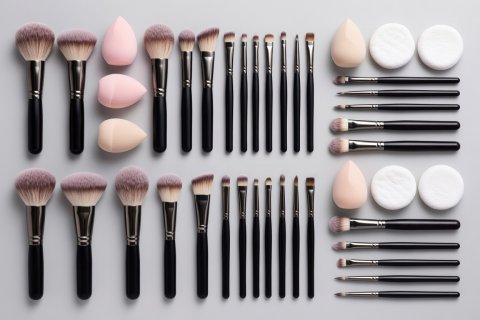
Many makeup enthusiasts blame the pigment quality of their eyeshadow or foundation when the issue is the application tool. Every makeup brush or sponge serves as a mechanical filter that either packs, disperses, or shears pigment:
- Dense Flat-Top Kabuki: Delivers full color payoff because bristles are closely packed, pressing liquid and cream formulas flat against the dermis.
- Dampened Hydrophilic Sponge: Absorbs water-based binders and diffuses color, lowering overall pigment coverage by approximately 40% for a natural wash.
- Loose Tapered Squirrel or Synthetic Feathers: Shears out high-intensity powder blushes, preventing sharp color lines on the cheeks.
Liquid, Cream or Powder: Comparison Matrix
| Formula Type | Underlying Behavior | Best Skin Surface | Color Longevity Strategy |
|---|---|---|---|
| Liquid Tint / Serum | High fluidity, lowest dry-down resistance; allows natural skin undertone to shine through. | Normal, Dry, or Dehydrated | Must be set with a delicate mist or micro-fine translucent dusting to prevent migration. |
| Cream Compact | Rich in waxes and emollient oils; produces saturated, bendable color depth. | Dry to Balanced | Layer a coordinating sheer powder blush over cream blush to lock pigment for 10+ hours. |
| Baked or Pressed Powder | Talc, mica, or silica based; absorbs oil and provides immediate diffuse matte pigment. | Oily, Combination, or Humid climates | Apply only over completely dry or set foundation to avoid pigment clumping and streaks. |
The 5-Phase Color Assembly Sequence
Surface Hydration & Film Formation
Apply moisturizer and broad-spectrum sunscreen. Allow a full five minutes for the emulsion to form a stable film on your skin. Applying foundation directly over wet moisturizer breaks the suspension, causing pigment pooling in pores.
Central Face Base Placement
Deposit foundation in the center of the face where redness and discoloration concentrate (around the nose and chin). Buff outward toward the hairline and jaw with fading pressure, ensuring no hard product lines at the jaw perimeter.
Targeted Concealing & Neutralization
Apply corrector to dark inner eye hollows and pinpoint spots. Do not sweep concealer across the outer eye crease, as continuous smiling will cause early creasing.
Cheek Elevation & Harmony Blending
Place blush on the upper cheekbone plane rather than the apple of the cheek if you want a lifted structural silhouette. Angle the blend back toward your temple hairline, ensuring the color merges with your eyeshadow transition shade.
Lip Line Calibration & Setting Mist
Line the lip perimeter with a shade matching your natural lip undertone. Fill with your chosen formula, then finish with an alcohol-free setting mist that bonds powder and liquid layers into a cohesive single finish.